
Girls Are Saving Wrestling, Part Two: The Breakthrough
From Opportunity to Championship
The first NCAA women’s wrestling championship gave a growing sport an official college title—and brought the path from youth clubs to college arenas and the Olympic podium into clearer view.
By J.R. Casarez
DETROIT, MI — In March 2026, 180 women entered Xtream Arena in Coralville, Iowa, and turned a long campaign for recognition into the first NCAA women’s wrestling championship.
They had earned their places through six regional tournaments. The top three wrestlers at each weight advanced, creating 18-person brackets across 10 weight classes. For the first time, women from all three NCAA divisions competed for an official NCAA wrestling title on the same stage.
McKendree won the inaugural team championship, edging Iowa 171–166. North Central finished third, and Michigan’s Grand Valley State placed fourth. Grand Valley State’s Katerina Lange won the 138-pound title. Iowa’s Kennedy Blades won at 160 pounds less than two years after taking Olympic silver in Paris. The connection between college wrestling and the world stage was there for everyone to see.
The NCAA championship was new. The work that made it possible was not. College women had competed for national titles through the National Collegiate Women’s Wrestling Championships, with Iowa winning the final coalition-run tournament in 2025. McKendree, North Central and other programs had built championship traditions before the NCAA awarded its first trophy. Coralville was a breakthrough because the sport’s governing institution formally recognized what wrestlers, coaches and schools had spent years creating.
That recognition followed a clear rise in participation. Women’s wrestling entered the NCAA Emerging Sports for Women program in 2020. In 2022–23, 51 NCAA teams had nearly 800 athletes. The sport crossed the 40-school varsity threshold for championship consideration, and 76 schools reported sponsoring women’s wrestling in 2023–24. By 2024–25, the count had climbed to 95 schools and more than 1,700 student-athletes. When the NCAA approved championship status in January 2025, it reported more than 1,200 women wrestlers competing at NCAA schools.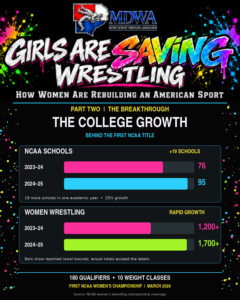
Those figures represent more than new teams on athletic department websites. Each program offers another room to train in, another coach who can recruit a high school girl, and another chance to continue the sport while pursuing a degree. A wrestler can now set her sights on a college roster and an NCAA final without treating her education and her athletic ambitions as separate futures.
Colleges have reasons to invest, too. Women’s wrestling can expand athletic opportunities and bring new students and visibility to a campus. Schools with wrestling facilities and experience may have a starting point for building a women’s program. But the strongest evidence is the athletes themselves: enough women wanted to compete that schools built teams, those teams grew, and the sport earned a championship.
Much of that growth came from outside Division I. In projected 2025–26 NCAA sponsorship figures, Division III accounted for 59% of women’s wrestling programs and Division II for 35%. Division I accounted for just 5%. Smaller schools helped carry women’s wrestling to this moment, and McKendree’s title over Iowa put that history at the center of the first NCAA championship.
Now larger programs are responding. In April 2026, Iowa State announced that women’s wrestling would become its 18th varsity sport, beginning competition in 2027–28. The Cyclones plan 30 roster positions and 10 scholarships and named two-time world silver medalist Alli St. John as the program’s first head coach. It will be Iowa State’s first new varsity sport since women’s soccer was added in 1996. The decision adds meaningful opportunities while showing how far demand for the sport has reached.
The college system also gives American wrestling something it needs internationally: more athletes training freestyle year-round with coaching, strength and conditioning, sports medicine, and regular competition. Women wrestle freestyle in the NCAA and at the Olympic Games. The competition levels differ, but the styles connect. Blades made that relationship tangible—an Olympic silver medalist in 2024 and an NCAA champion in 2026.
The Paris Olympics showed the strength of the U.S. women’s pipeline. Sarah Hildebrandt won gold at 50 kilograms and Amit Elor won gold at 68. Blades earned silver at 76, while Helen Maroulis took bronze at 57. Maroulis had become the first U.S. woman to win Olympic wrestling gold in 2016; her Paris medal was her third at the Games. Together, the four medalists showed both the depth of experience in American wrestling and the arrival of a younger generation.

Women are also shaping what the sport looks like beyond competition. Hildebrandt, who developed as a college wrestler at King University before NCAA championship status existed, worked as a commentator for the inaugural championship broadcast. St. John is building a new program at Iowa State. Their roles give younger wrestlers examples of women as coaches and public voices as well as champions.
This is how a sport builds a future. A girl sees an Olympic champion and decides to try wrestling. A youth club gives her a place to begin. A high school team helps her develop. A college offers her a roster spot and a chance at a national title. Years later, she may be the coach, broadcaster or mentor who brings someone else into the room.
The pathway is more visible now, but access along it remains uneven. Division I opportunities are still scarce. Geography, qualified coaching, training partners, travel and financial support can determine how far an athlete is able to go. The championship cannot solve those barriers by itself. Its arrival gives schools and wrestling leaders a stronger reason to address them.
The structure is already growing. Division III has approved its own women’s wrestling championship beginning in the 2027–28 academic year, giving athletes at those schools a title contested among similarly situated programs. That next step reflects a sport with enough teams and talent to require more than one model for its future.
Women’s wrestling no longer has to argue that an NCAA championship could exist. It exists because generations of athletes kept competing and institutions chose to make room for them. The question now is how many more girls will get the coaching, resources and opportunity to reach that stage.
For a young wrestler stepping onto the mat today, the route from a first practice to a college final and an Olympic podium is visible. Building a sport worthy of her means making that route possible to follow.

Have a question, feedback, have a wrestling story worth telling or want to support BTS? Contact J.R. Casarez at jrusso@btsdetroit.org.